Sunday, November 23, 2014

Commerce and guilt

I've been writing some about my transition to an increasingly sales-focused role, though the fact is, it's not my first time.  I had a spell as a consultant when I was selling my firm's services, looking for clients, spinning what we could do. The big difference is that now, more than ever before, what I am selling is my own services.  Though actually, in some regards it's not all that far from being an academic, going to conferences, presenting one's research, because that was all about trying to win the audience over to your point of view, and trying to be the best one on your panel.  And one of the keys to it then was to always have the shortest paper with the fewest points to make.  People loved it when you got done before their eyes glazed over.

But it's different when you're asking people to entrust their money to you.  It's a big ask. And people have a negative association with sales, in particular financial sales, but sales in general.

And some recent conversations have made me think back to what I think may be the best post I ever wrote here on the Grouse, certainly one of the most amazing conversations I ever overheard.  It was on the NJ Transit train from Metro Park into Manhattan, a mid-afternoon train.

10/27/4
I slunked into a seat and broke out my lunch. Roast beef on rye, fritos.

Across the aisle from me sat a woman sitting facing her roughly thirteen-year old daughter, dressed in a hot pink shirt, jeans, sneakers. I munch away, not paying much attention, until I hear her say to the girl: "And now I want to talk to you about negotiations. What happens when a supplier is trying to get a higher price out of you and you want to keep the price low" (door opens, random train noise) "You've got to always keep a stone face, impassive. Never let a customer get to you. If you have feelings, save it for home, for the dinner table."

By now I'm convinced that I'm not hallucinating. The mother is briefing the daughter on how to be a merchant. At this point mom reaches down and takes the daughter's hands in hers: "(train noise) is going to teach you about cash control, inventory management... there are three types of corporation: a sole proprietorship, a C corp, and an S corp (open door)... You should always have more than one product, and never buy stock in a company with only one product."

And so she went on, passing to her daughter all the rudiments of trade. And always very tenderly and solicitously, never turning imperious. I looked at the daughter to see if she was bored and annoyed, but no, she was fine, listening to Mom hold forth.

Wild. It was like a whole nuther dimension. My mom fancied herself an entrepreneur, even went to the White House for some small business hoo-ha when (cough cough) Reagan was occupying it , but she never passed on the gems to me like this. Just the parable of the talents, and some yummy frozen tacos for the nights she got home late from the office.

This conversation was so striking to me because, having been raised somewhat Christian, certainly liberal, often in quasi-Marxist circles, I circulate within a world which is at the very least profoundly ambivalent about money and material success.  We all like to live nicely, and we appreciate a good bargain, indeed we search for them, but we tend to regard commerce as low and dirty, even as we benefit from it.

So the idea that a mother could be instructing her daughter about commercial education in this deeply loving way was just bizarre.  And yet every day now, time and again, I put myself out there asking people to let me help them with their money.  After working my ass off for many years to get to the place where I'm skilled enough to be able to help them.  And it's hard at times to get past the wierdness of it all.

In truth, the cultural rift here goes back to the way Max Weber elaborates out the way the concept of salvation differs from Judaism to Christianity.  In short, the way he saw it (could be wrong), Jews believe in this-worldly salvation, whereas Christians believe in other-worldly salvation.  Which endows us with profoundly differing feelings about commerce and profit.  Hence "It is easier for a camel to pass through the eye of a needle than for a rich man to enter the kingdom of heaven."

Tuesday, November 18, 2014

Big Fish

I had been meaning to introduce myself to Daniel Wallace, who lives just over the ridge from me, but it seemed like it would be polite to read one of his books before doing so.  So I snapped up a copy of Big Fish at Nice Price Books, or maybe at the thrift store.  Dunno.

But when I peaked inside, I saw that it was about the death of his father, which seemed a little close to home. So I put it aside Then, leading up to the release party for a new children's book he has out, I thought I'd read a little.  I knew I could use a little fiction.

So I looked everywhere for it, but couldn't find it, until Sunday, when I found it.... just where I thought I had put it. It was as if I had been purposefully blind to the thing.  I started to read it, and have found it relatively easy going, cast in a mythopoeic groove just this side of Carl Sandburg's Rutabaga Tales.  It didn't seem too close to home at all.

Until it did.  All of a sudden we find the narrator sitting at the side of his father's deathbed, in multiple versions, like Rashomon, or the multiple versions of Abraham and Isaac with which Kierkegaarde opens Fear and Trembling.  And his father, lying there in what promises to be the location of his last breaths, keeps his family members at a safe distance by telling jokes.  Constantly. The son tries to get him to be serious, to no avail.

Thing is, some of them are good.  Like the one about the kid who keeps dreaming that kinfolk are dead, and then the next day they die.  So one night he dreams that his father dies.  And the next day the father paces back and forth in agony, fearing his imminent demise.  At the end of the day he's fine, but he says to his wife:  "Good god, I've had the worst day of my life."  And she responds, "you think you've had a bad day, the milkman dropped dead on our porch this morning!"

Mindfulness

I have never taken a yoga class, so I have no idea whether I'm using the term mindfulness correctly. And I don't feel like looking it up.

However, I will say that having an injured right hand -- and this is my strong hand -- certainly encourages what I think of as mindfulness.  That is, thinking about what I'm doing, trying to be purposeful in my actions. Because if I am not "mindful", to my way of thinking about it, I can aggravate my hand doing almost anything.  And, sad to say, I do.  Pulling back the blankets on my bed, getting into the car, etc.  Almost anything can tweak it and make me go "ouch."

So, I was thinking about this while making lunch.  And I opened a new bag of baby carrots after cutting some cheddar, only to realize that I had been insufficiently mindful of what I was doing from the point of view of Graham's dairy allergy.  So I had to put the carrots in a new Ziploc bag.

Sigh.

Monday, November 17, 2014

Graham sweeping the deck

One of Graham's chores is to sweep stuff off of our back deck.  Yesterday, after I pushed leaves off of the roof, there were a lot of leaves there, so we sent him out to take care of it.

Through the rear windows, we watched him take care of business.  He would push the big push broom around, sometimes in a little dance maneuver, and then stop, and look out across the lake at the sun as it got low on the horizon, lost in thought.  Then he laughed a little, and kept going.

He did a decent job on most of it.

Sunday, November 16, 2014

Change of pace

I have gotten into something of a rut in my reading.  It is probably hard to imagine how that might happen, given that I have read maybe 3500 pages by one white guy over the last couple of years, in biographies of two white guys.  And then, on weekdays, I read the Wall Street Journal every morning, and then the Economist during the week.

On Sundays, to mix things up, I read the Sunday Times in a less practical order.  First I read sports, then I resist the temptation to read the business section, and instead work through the Review section, which focuses on bigger, slower-moving questions of policy and/or life, death, etc.  It is all very Bob of me, I know.

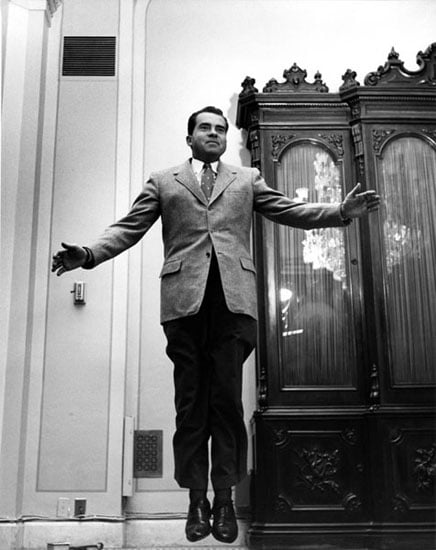
So today I decided to mix it up.  I've been conscious of feeling a little bit frumpy while I've been out in the world calling on people during the week.  These barbershop haircuts I've taken to have been getting pretty loose pretty quickly, and all of my pants are too big, because somehow I've managed to lose weight and keep it off over the years, without really trying too hard. I picked up the Style section of the Times, figuring I'd look at lapels and shirts and shoes and whatnot, to get an idea of how I might refresh/reboot myself, Instead, I found myself looking at the profile of one Anya Hindmarch, leading British handbag designer,  And in particular how she had been inspired by Philippe Haisman's jumping photos, which I had never heard of, but which do, as she notes, bring levity to some pretty sour people.  Below there's Nixon.  And then I read about Olafur Eliasson, which was a name I knew but didn't know much about.  Now that I have read 3 pages about him, I still don't know much, except that he sounds pretty cool.


I also got an infusion of Bloomberg Businessweeks from the office.  My subscription had lapsed.  Compared to the Economist, it is like candy, but that's good.  I can lie on the couch and read it and hear about stuff I didn't know about.

Certainly, I need to read some fiction.  I've been looking around my room for a copy of my neighbor Daniel Wallace's Big Fish, but I can't find it.  Had been hoping to knock it back before his book release party tomorrow.  Had tried to read it 6 months or so back, then saw it was about his dad dying, which was a little too close to home.*

In any case, this reminds me that I need to stay diverse to stay fresh.  Yes, it's important for me to read the articles about how doubling up in itemized deductions in one year and then using a standard deduction the next can result in tax savings over time, but assholes aloft are important too.


*Found it!  Right where I thought it should be.  Somehow I missed it the first two times I looked for it.

Saturday, November 15, 2014

Population growth and assimilation

Tyler Cowen had a piece in last week's NYTimes about how important a driver of economic growth population will be in decades to come, and how societies that can assimilate newcomers will have a competitive advantage over ones that can't.  So, the USA and the UK, for example, will have advantages over Japan, China, and Italy.

That took me back to a couple of moments over the last few weeks of ranging across the Triangle. One of my regular readers has made the point that, however liberal Chapel Hill may think it is, nice restaurants do not hire lower-income people, and particularly people of color, to serve as wait staff.

Recently the labor market seems to be changing that. At Bull City Burgers and Brewery in Durham, for example, an African-American woman who clearly wasn't brought up middle class was working the front of the house.  At the University Club the other night, an hispanic guy was serving deserts and an hispanic woman was busing and serving coffee, etc. There was something else but Mary just distracted me.

Oh yeah, on a tour of the homeless shelter at Urban Ministries of Durham, I saw help wanted ads for Hardee's and Bojangles.

All this says to me that labor market pressures are making it harder and harder to fill roles, which are opportunities for assimilation and growth.

I know you're thinking, big fucking deal, people of color getting shitty service sector jobs that don't pay well.  The point is that they are turning up in higher-touch, client-facing roles in more expensive types of food service establishments, the kinds of places that have historically preferred to hire younger, somewhat career-confused middle-class white kids. And that is where one learns how to deal with demanding customers, more complicated service needs, and more fluid processes, which are themselves more susceptible to improvisation and improvement.

Friday, November 14, 2014

At Rite Aid

In Roxboro today, we stopped in to see mom's cousin, who works there, and who had recently lost a sister.  She was happy to see us, and in fact said that the lord had sent us by to brighten her day.  I'm fine with that.

While we were talking to her, an African-American guy was buying some lottery tickets, then he asked if he could use the store's phone.

A heavyset woman in her twenties then asked if a photo she had submitted for printing over the internet had been printed.  It had. It costed 20 cents.  She reached into her change purse, and gave mom's cousin two dimes.

Wednesday, November 12, 2014

Features and benefits

I met with a woman early this evening to talk about potentially working with her, and I started off by talking about how we help clients, and then we talked a bit about her situation, what she owns, what she owes, etc.  Maybe 20 minutes into that she brings the conversation back around to her goals, which is where I should have started.  This is what is meant when we speak of leading with benefits rather than features, because nobody really gives a hoot about what any product or service does, they want to know how it will help them.  And rightly so.

In any case, no biggie.  Another piece of wisdom I am gleaning is to focus less on what I did wrong, and more on what I did right.  And the next thing to do right is to set up more meetings, where I can do them even righter.

Meanwhile, I got home early enough to go pick up Natalie from Mock Trial, and then after Graham and I unsuccessfully scanned the internet for Episode 7 of Avengers Assemble, Season 2 (it won't air until Sunday), so we had to watch an episode of some Spiderman thing.  Not as good.  Mostly, I am sad that they cancelled Young Justice, which was most righteous.

Monday, November 10, 2014

Books are so long

I'm reading Tim Tyson's Blood Done Sign My Name, which is a good book.  It's about racial politics, the KKK, and so on in North Carolina, specifically in Oxford, NC.  This is rather close to home.  My mom's dad owned a couple auto parts stores, one in his hometown of Roxboro, the other in Oxford.

The book is kicked off in 1971, when a black guy goes into a store in the ghetto owned by a virulent white racist, and is chased out into the street, pistol-whipped, and then shot dead.  This was when I was 5.  My granddad's store was right around there.

Not shockingly, some violent rioting ensues, rather Ferguson-like.  Black people burn up a bunch of shit, then the white power structure of the town lays down the law and puts a curfew in effect.

Anyway, it's a good book, I'm glad I'm reading it, but it goes on for 320-odd pages.  I feel like the material could have been handled in maybe 200-250 or so.  It seems like there's a bias in non-fiction towards bulk, as if a shorter book can't encompass a serious topic.

Sunday, November 09, 2014

Aftertaste

I'm still digesting this week's midterm election results.  Here in North Carolina, what particularly rankles is the vindication of the Republican legislature that comes not only from Tillis beating Hagan but from their picking up a seat in the state senate.  That's hard on our boy Josh, and it's hard on us.

What makes it worse is looking at the map of the painfully gerrymandered congressional districts that let the Republicans take all but three congressional seats in Washington, and how Tillis's narrow margin of victory clearly reflects the success of the Republicans' making it hard for college students to vote.

And it will be worse in 2016, when voter ID laws come into effect.

It is rather dispiriting to see Tillis sent to Washington, after reading the history of the Senate with which Caro begins Master of the Senate, volume 3 of the LBJ bio.  The US Senate, with its 6-year terms which provide for a third of the chamber to turn over every two years, was designed by the Founding Fathers to be a brake on law-making, to make things go slowly, and throughout its history it has fulfilled that function pretty darned well, and has been driven by white southern bastards like Tillis.  The first half of the 19th century was spent dithering over letting states into the Union so as to maintain a balance of power between free and slave states, and for much of the 20th century and into the 21st, the Senate has been a place where southerners have trumpeted the doctrine of states rights as a constraint on such noxious efforts at the "dangerous concentration of power" inherent in things like federal anti-lynching laws, or the dreaded Obamacare.

------------

So last night I was at a fundraiser here in liberal Chapel Hill for an excellent organization (skjajafund.org) that provides funding for lower-income kids to do afterschool and summer activities, take trips and the like.  As is all too often the case, almost everybody in the room was white, except some kids and representatives of an organization that received money from it.  This happens all too often.  It is hard to change things.

Saturday, November 08, 2014

Moving to the ball

So I keep meaning to post something about the elections, UNC's scandals, etc., but the spirit isn't moving me.  Then I make the mistake of scrolling through Facebook, or through one of my email inboxes, which sucks the spirit right out of me, so that I want to go eat.

Natalie is at an ultimate frisbee tournament today up in Norfolk.  They are away for two nights, staying in a hotel, with 5 girls to a room.  Awesome.  This is a first for her, being away from us, sharing a room with friends.  She will remember this for a long time.  Hopefully the experience will be enough to spur her to want to keep with the team sports.  She continues to be much more into the team part of it than the sports part of it.  Which is fine.

Actually, I was at an all-day tournament with her in Raleigh a couple of weeks ago.  She announced Friday at 9pm -- having come home from a football game at the high school -- that she did in fact want to go to Raleigh and play.  It was news to me that there was even a tournament to go to, but she wanted to go, and she needed to be there by 8 am, so there you had it.  Up early, off to the Biscuit Kitchen for some fortification, and off  we went.

I knew that I had to get back there by the end of the day to pick her up, and there were other parents there, so I decided to stay for the whole day and watch and cheer.  As I watched her, I saw her familiar pattern of kind of going through the motions on office, executing the plays the coaches had taught them, but not really doing a good job to insert herself into the run of play because, in fact, she didn't want the frisbee, because she didn't and doesn't believe in herself as a player.

Much of that is because of lack of practice.  She goes to practice a couple of days a week -- when it doesn't conflict with Mock Trial, or Model UN, or Debate -- but she doesn't really try too hard to improve her technical skills with the disc:  throwing, catching, important things like that.  Since she's doing something athletic and having fun and deepening friendships, I resist the temptation to jump in there and push too hard.  Eventually the peer pressure from teammates should push her to focus more, or she'll quit the sport.

But back to the main behavior, this being near the ball, pretending to be part of the play but not forcing herself into it for lack of confidence:  I recognize that from my own development.  Even now it is an issue.  In the past when I have had activity metrics goals put in front of me (number of times cited in major publications, number of reports published, etc.) I have often been able to make them, but have not figured out how to translate them into revenue.  The difference is that then I was salaried, but now I am paid for production.  So I have to actually be certain that I go and get the ball and put it in the back of the net.

Which, to some extent, explains why I've been blogging less.  I'm going and getting the ball.

Tuesday, November 04, 2014

Parking ticket

I was headed in to lunch in Durham, and had parked in the lot off of Parrish Street behind what is now the old courthouse, but which didn't exist when I was a kid and I visited my dad's office on Main Street.  I remember him going to what is now the old old courthouse.

So I was paying the newfangled electronic meter there, and it only let me pay in 1 hour increments.  Which rankles me.  I mean, lunch may at times run for an hour and a quarter, an hour and a half at the outside, but two hours?  It always seems like such a rip-off.

And I decided to gamble and just pay for one hour as I headed in at 11:55.  As I did to, I thought to myself:  if they are smart, they'll send somebody around this parking lot at just after 1, because they'll know that people have taken this bet.

Indeed, I was disappointed but not shocked when, as I returned to my car, I saw an orange piece of paper on my windshield.  They got me.  But it was only $10.  Luckily, Mary doesn't read my blog, so I should be OK here at the crib.  But I must take my hat off to the City of Durham and its parking enforcement team for doing exactly what they should be doing and making a quick pass through the parking lot right after 1.  Genius.

Saturday, November 01, 2014

A high point of college

So around 1987, in the fashionable literary criticism/theory circles at Yale, there was a moment when Jewish tradition became hip.  Geoffrey Hartman edited a volume on Talmud and criticism and had a seminar, Derrida did something too.  This was before the scandal over Paul de Man's WWII collaborationist journalism.  It was an innocent time.

I had been reading a lot of Kafka and had been intrigued by the fact that Kafka and Max Brod had, in the early 1920s, been drawn into low-brow traveling Yiddish theater and other emblems of their otherwise repressed Judaism.  Likewise I had been intrigued by the relationship of Walter Benjamin and Gershom Scholem, and had even purchased a volume of Buber's tales of the Hasids and put it on my shelf, though I never much of it.  In general, the concept of Jewish self-hate as manifested in the Jews of Vienna and Prague at the turn of the century was really forming a template for emerging ethnic and other repressed group studies concepts (African-American, Women's, LGBT, etc.).

So I, in my purist, holier than thou way, bad-assed do-anything-to-impress-the-girls kind of way, decided that rather than read more theory, I should go and look at the actual Jewish traditions of reading and interpreting holy texts.  There was a course called "Rabbinical Literature" offered, tought by a guy named Stephen Fraade, and I went and signed up for it.

I was the only undergrad in there, and the only goy.  Which was perfect for me.

So I learned about Pentateuch, Mishnah, Midrash, Gemarah, Talmud, and other stuff, as well as hermeneutic principles (from general to particular, or vice versa), and the main schools of thought (Rabbis Ishmael and Akiva, I think).  Thank goodness there's Wikipedia now to refresh my memory.

So there I was in the Judaic Studies reading room, way up high in Sterling Library, with a bunch of Judaic Studies grad students trying to figure out what the hell I was doing there.  And I had the most profound experience of my whole formal education.

So there is an injunction in the Mishnah against transacting commerce on the Sabbath. Fair enough, we gentiles have that kinda thing to.  Hell, there are dry counties in NC, and in Connecticut liquor stores closed at 8 and no alcohol was sold on Sunday. There was discussion in the Rabbinical literature and in our class of whether or not it was cool for the baker to put a loaf of bread on the sill of his window, and for someone who wanted the bread to take it and put a coin there.  Did that constitute commerce, and thereby violate the ban?  And the rabbis and the students bickered a little on this question, but basically they came down and said:  no no, that's cool, that's not commerce.

But I sat there, quietly, and thought to myself:  "That's outrageous!  Of course that is commerce. Even though there is not a direct exchange of bread for money, they both know what they're doing."  And then I realized, that what was welling up within me was right at the heart of a huge, multi-millenial debate.  We have Paul in Corinthians saying "for the letter killeth, but the spirit giveth life."  And this rumbles on through the ages, from Montesquieu's The Spirit of the Law through the judicial activism of the Supreme Court, especially under Earl Warren, down to the countervailing forces of strict constructionism and loonie Tea Partiers toting around constitutions they haven't read.

The whole Letter/Spirit thing is huge, and between Jews and Christians (or Orthodox and Reformed Jews) it can be a thorny issue.  How outrageous does it seem to turn on the TVs before sundown on Friday and leave them on all Saturday so as to evade a stricture against using machines on Shabbos?

And there it was, right within me in that class. Well worth the cost of admission.

Tuesday, October 28, 2014

In the moment

At AA the other day there was a lot of discussion of what it means to be in the moment, a worthwhile and complicated topic.  There was a lot of good and thought-provoking discussion.

Then all of a sudden a guy started sharing about having been in prison and, one night, having been awoken by the sound of some guys murdering another guy.  Then waking up the next day and nobody talked about it at all.  And how being in the moment helped him get through stuff like that.

I will confess that I was a little jarred by that. One of the great things about AA is that it provides a forum where you can be in with a bunch of people you otherwise would have little contact with.  Come to think of it, drugs and alcohol can do that too, but in a less good way.  But every once in a while something comes up in a meeting and I'm just like:  I didn't really need to hear about that, and I'm glad I don't deal with that a lot.  My sponsor pointed out that it was a pretty good argument for staying away from a drink, and I've gotta give him that.

Sunday, October 26, 2014

The New Yorker and endless fascination

Over the last couple of months, I've two of three chapters in John McPhee's Encounters with the Archdruid, and I've also been making my way through Peter Hessler's Strange Stones.  McPhee is in many ways the archetypal New Yorker writer, and Hessler studied under him at Princeton, before going on to become the New Yorker's correspondent in Beijing, and now in Cairo.  Regular readers will recall my lavish praise of Hessler's three books written in China.

But reading a bunch of articles that were originally published in the New Yorker (as is the case for both of the books I'm reading now) is really dragging me back into the zone of that magazine, so everpresent around our house, but which I have largely been avoiding for some many years in favor of reading actual books.  The problem with both the McPhee, the Hessler, and with so many other articles published in the magazine, is that they really do embody the worldview so famously skewered by Saul Steinberg in his 1976 cover.  All the articles are really very similar in some fundamental way.  They tell us that "Here is this adventure, this person, this episode in history, this facet of world experience, so quirky, so fascinating.  We have laid it our for you in well-turned prose, in a readily consumable unit, that can be gotten through while riding a commuter train, or enjoying a capuccino, or perhaps a nice pinot noir.  When you have done reading it, you can go discuss it with your peers over dim sum or gaspacho or perhaps while running around the reservoir.  And then, you can stack it in a corner in the attic so your children can find it."

In the end, it's all the same, all experience is boiled down for the global New Yorker.


Thursday, October 23, 2014

A fairy tale

Astonishing as it may seem, I have never blogged about this, at least as near as I can tell.

So, back in 1997, Mary and I were planning to get married in June, and one Sunday (I swear it was a Sunday).  We were trying to figure out what to do for our honeymoon.  My idea was to throw the dog in the back of the old Volvo and drive through the maritime provinces of Canada. So we were sitting around the apartment in Greenwich Village when the buzzer rang.  It was an extra super-duper special delivery from some service.  I think it was US Mail, but that seems impossible, so it must have been something else.

It was an announcement from the Dicasterere di Turismo i Cultura della Republica de San Marino -- you can probably figure enough of that out if I just remind those of you who might not know that San Marino is a microstate completely surrounded by Italy with population of 25,000.  It told us that Mary had won the Romeo Martinez International Photo Prize, which included an all expenses paid trip to San Marino for the International Photomeet there, as well as a cash prize of 5,000,000 lire (this was pre Euro days), or about $3,000.

This sort of solved our honeymoon thinking, as the Photomeet was gonna be a few weeks after our wedding.

And the really crazy thing is, there's almost no evidence anywhere on the internet that this Romeo Martinez Prize or the Photomeet actually happened.  Like maybe 10 hits on Google.  It appears to have happened maybe twice, in 1997 and again in 1998, when the prize was won by a Mexican photographer.  But, like the flower in the desert, there it was, funding our honeymoon.

Somewhere around this room we've got a catalog from the Photomeet, and I've got honeymoon pix from San Marino, which was kind of a tourist trap but a perfectly decent place to get over our jet lag before continuing on to an awesome trip.

Monday, October 20, 2014

Arroz con pollo inflation

Knowing as I did that I would not be able to go out for lunch tomorrow, as I will be occupied with a hired photographer shooting headshots of me for the company web site, I went to Jamaica Jamaica at the intersection of 54 and 55, and got myself jerk chicken with yellow rice and black beans, along with a beef patty, for lunch.  This is enough food for two meals, which makes me square for tomorrow.  The guy behind the counter asked if I wanted gravy, and of course I did.

On my way out the door to go hear John Elder Robison at Duke, I paused to inhale a drum stick and a nibble of rice.  As I did so, I realized that this was very much like the quarter chicken with rice and beans that I used to get for $3.49 at La Floridita at Broadway and 125th, a fine little establishment which -- like so much -- has sadly yielded to Columbia's imperial march northward into Harlem, spurred ever onwards by Lee Bollinger, that deft combination of Chuck Norris and Napoleon Bonaparte.  But I digress.

And indeed, today's container or rice, beans, and chicken was very much like the one from back in the day.  The pricing is a little different.  According to this handy US inflation calculator,  $3.49 inflated from 1995 to 2014 balloons up only to $5.45, whereas I think my lunch today costed $7.50 or $7.99, something like that.  Admittedly, there was more chicken, and the spicing was much tastier.

I don't think it's a question of rent.  I think what this mostly likely reflects is a combination of food inflation outpacing inflation more generally, and the relative availability of meals.  There were multiple Dominican places close to 125th, to the chicken and rice at Floridita was kind of a loss leader, and the assumption was a fair amount of beer would be sold with it, along with more expensive plates.

Sunday, October 19, 2014

Post-Modernism and Ebola

The Wall Street Journal had a good piece this weekend on how our attitudes towards medicine and epidemiology are tripping us up in our response to Ebola.  In short, it argues that in generations past, heroic advances were made in the control of infectious diseases in part because we trusted the medical research and public health apparatus to do its job, and believed it could be done.  Most convincingly, it cites how 2 million live American children were used to study Jonas Salk's polio vaccine, and recounts how Dwight Eisenhower held back tears in personally thanking Salk.

Many things have happened in intervening years which have eroded the trust we have in medicine and science. The article notes that the heroic conquests of the past have slowed as the great threats of the time (smallpox, polio, chicken pox, mumps, etc.) were neutralized.  Certainly we still struggle mightily with cancer, but even AIDS has been largely wrestled to the mat if not quite pinned.

The at times unholy alliance of pharma and medicine with profit in what -- to echo Eisenhower himself -- we might term the "medico-pharmacological complex," has not helped, nor has the perceived drifting of medicine as career from a "calling" to a way of maxing out income and securing for onesself ever larger cars, houses, and more prestigious club memberships.

The continual flipping and flopping of thinking about this that or the other nutritional point ("Eat margarine... no eat butter") hasn't done much to raise trust in science and doctors.

And certainly, for those of us who like to think of ourselves as being at the top of the intellectual food chain, post-modernism hasn't added value either.  The skepticism towards science and enlightenment values found in Thomas Kuhn, Jean-Francois Lyotard, Paul Feyerabend, and a host of others raised up a whole host of cynics.... blah blah blah

Anyhow, when all's said and done, western medicine has saved my butt on a number of occasions, I'm inclined to cut it some slack.  At this very instant, for example, science is telling me that I have been blogging too long (I thought I had a succinct point to make earlier) and I need to go running on this beautiful autumn day before I get too hungry to do so before lunch.

More later!

Monday, October 13, 2014

A little jig

As I rounded the bend on the way home, I saw a 14-year old girl who walks her dog around there, we shall call her Jennifer, and she was doing a little dance step while she perceived she was alone.  When she saw me, she stopped.  My initial instinct was to roll down my window and say something encouraging, but then I thought "48-year old guy saying something to 14-year old girl while driving by.  There's really no upside here."  So I passed by in silence.

But it was cute.

Saturday, October 11, 2014

Caro back in stride

Started back into Master of the Senate the day before last, and today I read Caro's masterful 16 pages about how Richard Russell of Georgia defuses the constitutional crisis caused by the triumphal return of MacArthur from Korea after Truman dismissed him.  This compared very favorably to the 100 pages the author had spent digging into every detail of LBJ's struggle with Leland Olds.  Sometimes Caro gets mired in the details, but when he can maintain a sense of proportion, he is without equal.

Later, I took Natalie to the Walk for Education fair at Lincoln, where she and her ultimate teammates played frisbee in pouring rain, which was beautiful.

Friday, October 10, 2014

Alienation and differentiation

I read this article last night off of a friend's feed on Facebook about how rich people and others who have extraordinary experiences (travel, for instance) are made not happier for having done so, but more miserable, because they have a difficult time sharing with others how awesome the experience was.  They, in effect, isolate themselves.

Driving in to work this morning -- with a lot of other people in unexceptional cars and most likely similarly undifferentiated office casual (Friday is jeans day here!) -- it occurred to me that this same line of thinking could be applied to much in our lives, but I was specifically thinking about cultural consumption/career paths.

So me, for example, with my PhD in Russian Literature and my youthful attempts to read and listen to and see more and wierder books and music and movies, really to demonstrate how smart I am -- because as a geeky kid that was the core of my identity, it was where I felt strong.  So the more I try to set myself off from others, the more I make myself one of a kind, the more I isolate myself.

Little wonder that I there are centrist aspects to who I am that are important for connecting to the rest of the world, to wit pizza, cheeseburgers (but a respect for aging and cholesterol), child-rearing, playing sports, AA, UNC Basketball, Talladega Nights, Moonstruck, Coming to America.... etc.  I do indeed love all that stuff.

In  the end, there's always a question of balance.  Veering to far off into differentiation can indeed get me in trouble, but I do gotta be me.

Thursday, October 09, 2014

Mood swings

After work today I went to a meeting about the lake, where a number of other guys and I flat out geeked out about the lake.  We're talking scientists now, carrying on about hydrostatic pressure on the dam and non-permeable membranes and channels and flow and insiltation all manner of jibber jabber. Mostly I just nod and agree because, in all honesty, I don't really want to do this stuff, I just want it to get done. I'd rather outsource it to other geeks.

And then I had to go and feed Natalie and Graham dinner because Mary had some kind of meeting, and I got kind of glum.  Maybe I was just hungry, but partially I was a little jealous of excellent trips I see friends of mine taking by way of their photos on Facebook, and me wondering whether I'm short-changing my kids on the experience side of life while I wrestle with the demons of bringing dollars into the house and self-actualization and all off that.

So I had breakfast for dinner, which was a good start.  Then Graham and I watched Episode 3 of Young Justice, Season 2, which is proving as good as Season 1.

Next Mary came home from her meeting, and told harsh tales of other parents whose kids have substantial learning challenges and who have to provide hours of homework support in the evening.  Somehow, that got me out of my moping.

For those of you who don't like play-by-play here on the Grouse, my apologies, but sometimes that's how I just gotta roll.

Tuesday, October 07, 2014

Singing along with Frozen

I know I've mentioned this before, but Natalie keeps singing along with the soundtrack of Frozen.  Around Graham's bedtime, she's got the soundtrack on the little boombox she has in her room and is just belting it out "For the first time in forever, blah blah blah blah blah blah".

I must say, I just love it.  Makes me proud to be a dad, and keeps me dedicated to staying on task in this whole revenue production thing.  I wasn't into the movie at first, but even then, I seem to recall, that the climactic scene, hokey and over the top as it was, probably brought me to tears.  That's the kind of sap I am.

Sunday, October 05, 2014

10 Years of Grousing

Today marks something of a watershed for the blog.  It is now 10 years since I started it, and I have now published 2290 posts.  Which ain't bad.  Even though my pace has moderated in recent years, that's still more than 4 a week, on average.

As time has gone by, the blog has served many purposes.  At the beginning, I saw it as a place to practice writing and chronicle stuff going on around the house, and it is still that.  A couple of weeks ago, Mary asked me about when Graham started reading, and I was able to search the blog and track down where I had put that down for posterity.  Also for Natalie.  Which is awesome.

It was also, frankly, a place for me to express vestigial graduate-student-ness, a locus for expounding/blathering on the Great Truths of Being that only I, of course, was privy to.

Over the years, thanks to some loyal and dedicated readers, ChewYourGrouse has also become a venue for the raising of penis enlargement pseudo-spam to ever higher levels of creativity.  It has been a massive, throbbing honor to be the host of such powerful spurts of manly artfulness.

It has also just been a good place for me to observe crazy shit I see and hear in the world, often while commuting.  Like the time I pulled up next to a woman near Kingston, New Jersey, who was eating a bowl of cereal while driving.  You cannot make that up.  You could hallucinate it, yes, but I didn't.

By now, I see the blog as a place where I try to be honest with myself and my readers.  Which is not always easy.

For those of you who have been reading regularly through the years and who occasionally offer encouragement, I can't thank you enough.  Although, I promote the Grouse only rarely and, in the end, I'm writing for myself, the idea of being a tree falling in a forest near the north shore of Lake Baikal is not entirely what I'm looking for.  For those of you here for the first time, I thank you too.  I consider myself graced by any and all traffic. As my distant cousins the Clampetts would say, y'all come by and set a spell.

Tuesday, September 30, 2014

I injured my hand

playing soccer,
      so now I am typing
             with only my left.
Posting may slow
                     even further
         than usual
It's not because
I don't care

Sunday, September 28, 2014

Joke teller

I was walking with Graham from the library today when I was reminded of a joke:  guy is going to a job interview, buys a suit, but one sleeve is too short and one pants leg too short (don't ask why).  So he scrunches up and walks funny to make up for the ill-fitting clothes.  And as he's walking through the park, a couple see him and one of them says: "Oh, look at that poor, deformed guy."  To which the other responds:  "Yeah, but what a nice suit he's wearing!"

And then Graham told me a couple of jokes.  And then I got sad, thinking of my dad, and all of his great jokes, most of which were age-inappropriate for Graham, but how it would have been nice for dad to be there to tell Graham some jokes.

I tend to forget jokes, because dad pretty much consumed all the joke-telling oxygen in our family.

Saturday, September 27, 2014

Responsibility

I had been switching between stopper and left back today in soccer, so I was momentarily confused in the second half when I was on the left and the opposing team a hit long ball down that wing and I was way out of position.  This pretty talented woman was running onto the ball and it was going be her against our keeper, so I hauled back at full speed to catch up with her, covered a lot of ground, and caught up with her just inside the box.  I got a foot on the ball and poked it out over the sideline, but as I did so I collided with her and as I went down, at full speed, I broke my fall with my hand and bent some fingers back hard.  It hurt like hell.

So I stopped a goal, maybe.  But I got injured, maybe (ask me tomorrow).

The thing about it was, it wasn't really that important.  But, because it had been on the flank I was supposed to be guarding, I felt an exaggerated sense of responsibility for it, and there was no way I was gonna let her score, if there was anything I could do about it, as indeed there was.

Others will say:  "But you're 48, you have to go to work on Monday."  And this is true, and I try to keep that in mind.  But when I'm in the game, I can't keep any distance from it.  There is us, and them, and the ball, and the goals, and that's it.  I can't let them score, if I can do anything about it.  If I can't, that's different.

And this is perhaps symptomatic of a broader tendency on my part to overestimate what my appropriate role in things, when I should let stuff go.  But I'll be damned if I could let her score.

Monday, September 22, 2014

Flowing downhill

So after torrential rains in recent years we have seen pretty intense erosion.  I'm sure it's not any worse than when I was a kid, it's just now I pay attention.

One of the things I have noticed is that, if you have a clear channel, things tend to erode more. Water flows quicker.  So it is good to have stones set irregularly into ditches to slow the flow of water, and make it more irregular.  I had in particular admired the irregular placement of rocks in the ditch of my neighbor across the street.  His ditch had relatively little dirt washed away (oh, the paucity of synonyms for erosion!) in massive storms of late.  I may even have commented to him on the Zen wisdom on it.

So this weekend he and his boys were out working on their ditch.  He explained that his neighbor down the hill -- a jolly retired fellow from Wisconsin who is truly enamored of our fair state and 'hood -- was cleaning out his ditch, so he felt he needed to clean out his own. OK.

But after he was done, I saw that he had pulled all of the nice, irregularly placed stones out of his ditch, and lined them in an orderly fashion along its side.  Yes, it looks neat, but he's gonna see more major soil loss and channeling going forward.  He and his boys worked hard at this, and I'm sure he taught them some important lessons about working hard and together and neighborliness.  But nature will have the last word, and that word will be, you guessed it, erosion. 

Sunday, September 21, 2014

An interview

So I would post this on Facebook, but since Natalie and I are friends there, I will skip it.   I'm 99% certain that she doesn't read my blog.

So Natalie went to a movie with a boy today.  Afterwards, when Mary asked her, Natalie insisted that this was not a date.  It was, however, with the same boy that she facetimes with an awful lot when doing homework.  And he is a very nice young fellow indeed.  If he proves in time to be Natalie's first boyfriend, I'm perfectly comfortable with it.

It was interesting, however, to learn that her father wanted to meet one of her parents when we were picking up his son to go to the movie.  It may have been a pretext for meeting Natalie, but I felt a bit like I was being interviewed. I decided at length not to shave, but I did put on decent shorts and a quasi-respectable shirt.  I was half expecting him to ask me:  "So, what are your daughter's intentions with my son?"

In the end, it was perfectly nice, as was he.  He even said "we ought to all get together sometime."  Which is fine.  I like me a little get together as much as the next guy.

Tuesday, September 16, 2014

The first time in forever

Natalie has been singing along to the soundtrack of Frozen around Graham's bedtime, but Graham says it doesn't disturb his sleep, so I guess it's OK.   Mostly, I think it's sweet.  And to think that by the time I was in 9th grade I was dead set on demonstrating how cool I was by being into whatever punk and new wave I could lay my hands on.  8th grade, after all, had been the year of the Buzzcocks, Human Sexual Response, and the Rocky Horror Picture Show.

But I wasn't too cool to go to Purdy's and dance to Michael Jackson, Kurtis Blow, and Xmas Rapping.  At least, not yet.

But in any case, I think it's good that Natalie is not yet a culture snob.

Social skills and intellect

I went running with a friend yesterday, a guy who has had a fascinating and successful career across a range of roles and industries -- not that he's super-rich, although he's comfortable, but that he leaps from interesting thing to interesting thing and his aura keeps getting better.

We ended up talking about kids, as guys often do, no matter what women think, and he said that his son had recently had some testing come back and that he had tested just below gifted, which he thought was perfect.  I had to think on that.  So much of my own sense of self-worth derives from having been smart, from having dominated people intellectually. I know that this isn't necessarily good, and hasn't always served me well.

And Mary and I definitely exult when our kids test well, and we praise them for it.

But my friend talked about his experience in life and how he had found over time that having good social skills was more important than being smart, about how he had figured that out working at an investment bank right out of college.

And one point he made about his test scores was that, in a high-powered school system like Chapel Hill's being placed on a gifted track put you in a more competitive pool of kids, and that social skills seemed to suffer there.  Which is very pretty good thinking.  I know that, looking back on high school from a 30-year remove, one of the things I did to myself by being in so many AP and Honors courses was to assure myself of being in a segregated classroom.  So now I know plenty of black guys from my class because I really strove to play basketball, but very few black women.  I know a lot of geeks, and am happy to know them because they are great people, but I have fairly narrow social circles.


I was also reminded of this article by Sal Khan of Khan Academy.  Encouraging academic and intellectual accomplishment can be, it seems, a double-edged sword.

Monday, September 15, 2014

Japanese Stiltgrass as metaphor

Japanese stiltgrass is a very invasive plant, and it is all over our neighborhood, and in other areas around here.  I had never noticed it until Mary told me about it, and now I see it all the time as I run, walk, drive, etc.  All of this is incontrovertibly true.

And I let it bother me too much, although it is really well outside my control.  Yes, we can try to contain it in our yard, and we do, but beyond that my sphere of influence with regard to it is extraordinarily limited.  I could try to promulgate awareness of it in our neighborhood using the listserv, that is true, but beyond that my hands are tied.

In this regard, it is like so much else in life.  If I let it get to me, I have lost the battle already.  I have to pick my battles, or I will lose.  Continually.  And I this does not make me happier.  Quite the contrary.

Sunday, September 14, 2014

Thoughts on Russia

I don't know what it was, but something spurred in me the memory of a decade or so back, when I was doing a project out in St Louis.  As was often the case, there was a Russian programmer at the client site, and I struck up a conversation with him in Russian, in the never-ending quest to keep my Russian skills from disappearing forever off into the mists of forgetting (as they will one day, for sure, but I will forestall it as long as possible).

Sergei, I think his name was, was typically delighted and amazed to meet an American who spoke some Russian, and invited me out to his home to meet his wife in the evening after work.  When I got to their house, a perfectly respectable if nondescript ranch somewhere in some subdivision, there was one small problem:  their dog.  Not that he was a nasty dog, quite the contrary, he was a lovely dog, the friendliest ever, perhaps.  An Irish Setter, I thinnk. You would have thought I was his long-lost chum from kindergarten.  No sooner than I had come in the house, then he lept all over me and wanted to kiss and lick and cuddle.  He was absolutely irrepressible.

I can't recall if I had told Sergei I didn't drink before I went over there, at any case, at some point in time it became clear that the best activity for the two of us was to play ping pong. So we played some ping pong, and spoke some Russian, and then to leave I had to pass through the kitchen again, where they had tried to isolate their hyperpup.  More jumping and kissing.  Though I could have done without some of the puppy love, this was a reminder of the extreme hospitality one often finds amongst the Russians.

These days almost everything we read about Russia is negative.  Putin taking back Crimea, waging a proxy war in Ukraine.  Russians attacking gays and lesbians.  Parliament passing crazily restrictive laws on media. Zhirinovsky threatening use of tactical nuclear weapons in Poland or the "dwarf states" of the Baltic.

I was up at Columbia University for a memorial service in honor of one of my professors, Robert Belknap, this Friday.  At the reception afterwards, I was talking to other faculty from Columbia, Princeton, and elsewhere, and they were basically arguing that -- despite Putin's huge approval numbers -- things weren't as bad in Russia in general as they are made out to be.  That life is better, that people are not as nasty as our mass media make them out to be, that the real solution is for Putin to be gotten rid of, somehow.  And that Putin's control is not as absolute as it is made out to be.

It's hard for me to know.  I haven't been back to Russia since '98.  But it is hard for me to believe that they are all fascists.  They have suffered, yes.  There is homophobia, and racism, yes, but we've got that too.

Sunday, September 07, 2014

Graham moving further forward

After talking about it for 2 years, I got Graham to swim all the way out to the float at the lake today.  Afterwards, we were sitting on the bench onshore, and he noted that it seemed closer than it had before.  I explained that he was bigger and stronger.

Teamwork and leadership

Mary was out of town this weekend, up in New York with her grad school home girls celebrating an opening for one of them and Mary's (dare I say it) 50th birthday. And maybe Tanya's too.

So this morning it fell to me to make the pancakes, as we do every Sunday, pretty much.  I had thought ahead and taken some pumpkin out of the freezer, because we all love pumpkin pancakes, and fall is after all on its way.  I looked in the cookbook Mary uses for making the pancakes, opened it to the recipe she uses, and proceeded from there, following the recipe as best I could.

Unfortunately, they didn't come out as good as they are when she makes them.  They were too dense, perhaps because we had only one egg, perhaps because I used more whole wheat flour than Mary actually does (despite what was written on the page).  Or maybe I left out some ingredient like baking powder because I am such a space cadet.  Anyway, they were perfectly fine with some maple syrup on them.

A little later, Graham and I were sitting on the couch talking about DC superheros and the villains they struggle with and on good days vanquish.  We were talking about favorites, and Graham focused a little bit on the villain Brainiac, who is said to be smarter than all of the denizens of earth put together.

I noted that, in fact, just adding up the intelligence does not adequately reflect the capacities of different types of people working together, and we see that in the comic books, where time after time, a foe who seems insurmountable at the outset is brought low at the end by the concerted efforts of some super teammates.

But I also made the point that the concept of intelligence is inherently not additive, that you can in no way just add up the IQs or any other quantitative measure of how smart folx are and have that in any way reflect their capacity to work together.

For example, I noted, why did my pancakes kinda suck?  I was following mom's recipe.  We've been married over 17 years. It's a simple task we do all the time. Mary had written down slight modifications to the recipe based on our own experience.  And yet they were too chewy and dense.

The transmission of knowledge and talents between teammates is inherently tough, but good leaders figure out how to make it happen.  Bad leaders don't.

Saturday, September 06, 2014

Do you want to be a salesman?

People keep asking me that.  And the answer is... kinda, but not entirely.

I enjoy much of the sales cycle.  The being out in the world, looking around, talking to people about their issues, searching for solutions, etc. I do not, however, enjoy the nudging and the asking and the closing, not so much. Mostly, I'm less concerned about maximizing my income and more want to be in a position to help people. Though I do need to get some income flowing, that's for sure.

Everybody always says that it takes time to develop a business and that one needs to be patient.  On the other hand, there's pressure to bring revenue in the door.

It is not always fun, or calming.

And the problem is, I am competing with people who are intensely money driven and want to win win win.  Where I have always been focused on playing well, in the belief that right will out.

Oh, the ethics of Rainbow Soccer.

Wednesday, September 03, 2014

The Murder of Roger Ackroyd

In a vain attempt to try to nudge Graham's reading taste forward, really to expand the set of books available to him -- because he has so picked over the offerings of the local public library that I marvel that he finds anything at all when I take him on our (greatly beloved) weekly pilgrimage there -- I checked out what I had heard was Agatha Christie's masterpiece, the 1926 The Murder of Roger Ackroyd.*  He turned up his nose at it.

I was about to return it to the library, when I thought I'd better Google it.  And lo and behold, I find it was voted sometime recently by like the mystery writers of the world to be the greatest mystery ever written.  Them's some big words.  Having never actually read a Christie novel, I thought I owed it a look.

So I didn't return it, and began reading it instead.  And, thus far, I'm not feeling it.  100 pages in, yes, it's mysterious.  And there, already in this early stage, we have Poirot, twirling his moustache.  But still.

Then again, it's only 200 pages long, and I'm 100 in, so I'll keep rolling with it.


Just realized that the story in the Times today about the DNA-based exoneration of two brothers in NC prison for murders 31 years ago is the work of my old next-door neighbor Gerda and her colleagues at the Center for Death Penalty Litigation.  Beautiful.


*Blech, what a sentence.  If this were anything but a blog, I would really go back and edit it.  But a blog it is, and so it will stand.

Tuesday, September 02, 2014

Graham moving forward

For a very long time, Graham refused to even discuss showering.  It made him a little teary, even.  I forget exactly what his objection was, the sensation of the water hitting his skin, it getting in his eyes, what have you.

But we had guided him and told him that in middle school kids took showers every day, and so one day in Larchmont we were telling him he needed to take a bath and he pulled out a shocker and said he would be taking a shower.

Similarly, some years before he had been grossed out by mayonnaise.  So, when we stop at Subways when we're on the road, Graham typically gets just a plain turkey sub.  But the other day I was giving him some chicken breast, and I suggested mayo, and he rolled with it.  And liked it. Indeed, what's not to like?  Oil, egg, all whipped up and creamy.  It's all good.

It's good to see these kinds of steps forward.  All told, our life just gets easier.


Monday, September 01, 2014

Money as a verb

I was reading in the Arts and Leisure section of the Times from a couple of weeks back about a female artist named Swoon,* who has grown from doing guerrilla installations to having big museum shows, and who seems very very cool and has her money where her mouth, heart, feet, and all other various internal organs are.  She talked about hiring armies of friends to assemble installations (and running over budget) and thereby bringing people together and creating mini-economies, and of "money as a verb."  She lives in the same apartment she first rented in her early 20s.

And that took me back to a scene from my youth, about which it turns out I have already blogged, here.  For those of you disinclined to go back and read the full post, Mike Watt, of the Minutemen, tells a guy making a documentary about them that "we look at money like this. It's like air, you need it to breath, but what are you gonna do, keep a bunch of oxygen tanks in your garage? So what's our plan? Are we going to accumulate a lot of these vouchers? No, we're going to return them to the market in exchange for goods and services."  This is a compelling way to look at money, for the young, it shows a certain trust in the world and in the concept of flow, which is the flip side of the idea of planning. 

That said, it is worth noting that within a month of my being backstage with the Mike and the Minutemen, guitarist D Boon died in an accident when he was lying on the back seat of the band's van, sick.  He was not wearing his seatbelt at the time.  Which was a tragic end to truly a brilliant band and a really good guy.

In any case.... with some minimal sanity in place (seatbelts, flossing), there is some poetic beauty in trusting the world.

Until you have children.  And then the game changes.  Because it is no longer about you and having fun and making some broad rhetorical/philosophical point about your values and those of others.  You have young lives you're responsible for, in some sense, and you need to instill in them the right values, or at least the sense of a healthy process for groping towards those values.

Not that it is simple.  How should I guide my children towards balancing pragmatism and wonderment?  I, on the one hand, went way off in one direction in getting a PhD in Russian, which dented my early life earnings in a big way.  Which is maybe not all that big a deal, given other advantages I've been blessed with.

So right now Natalie's starting high school.  She loves art and theater, but is very good at math and generally does well and shows a strong proclivity at the dining room table towards a legal career (i.e. splits hairs, parses the fine points of everything we say, etc.).  We definitely want to encourage her to do the things she loves.  At the same time, I know that she should for sure learn statistics and, honestly, it wouldn't hurt her to learn to program a little.

And for me -- and Mary, by extension -- the broader question is to what extent we should be conservative now financially to be able to provide our kids with the wherewithal to be impractical, and to what extent we should be seeking to instill in them a sense of joy and wonder.  As opposed to a fear of the world which pushes them towards hyper-practical paths which may or may not be fulfilling.

The answer, as always, is to stop blogging and move on with my day, because the truth is somewhere in the middle.


*Full hipster disclosure:  I had never heard of her before, and may very well never hear of her again.  Though she seems very cool.

Saturday, August 30, 2014

Consciousness-raising

Between ice-bucket challenges and BeLoud!Sophie and my brother-in-law Walter's raising more than $11k riding in the Pan-Mass Challenge for breast cancer research and Jack Pringle's solo efforts in Rowing to Gainesville for Tyler's Hope to raise money for and consciousness around Dystonia, I've seen a lot of noble and valiant efforts going into fund-raising for various medical causes.  Which is all very tremendous.

But it is also rather lossy and tends to direct funding to the squeakiest wheel.  Research $ tends to get attention to the extent that it impacts people with time, energy, and wherewithal to mount campaigns.

And thus, we have another example of the withering of the state, as Republicans would have it.  Allocating dollars for medical research is very much a public interest thing, and while bottom-up strategies and frameworks definitely have a place in determining how cash flows, there is also a need for top-down views that can take into account asymmetric risks.  Like, say, developing vaccines and treatment protocols for something like an Ebola virus.  It's good that some pharma and biotech companies are out there trying to look at that kind of stuff and other "orphan" diseases (which are within the pharma world are regarded as profitable niches), but a strong central strategic vision for medical research is important.

Net net, I think this is an important government function that should be funded.  And yet, the budgets of the NIH and other allied government organs are under considerable attack.  Which is no surprise within the Republicans' highly orchestrated War on Government.


Tuesday, August 26, 2014

Being in the Park

So now I am working in Research Triangle Park.  This is not something I was ever particularly excited about, it was, frankly, not my dream.  In fact, I don't think it's anybody's dream. What it is is convenient to people commuting from multiple directions. It's practical.

It is also, for me at this stage in the game, a little dangerous around lunchtime.  I'm poking around there trying to figure out how the roads connect to one another, what with all the buildings looking exactly the same and everything, and if I'm not 100% committed to a lane well, some other jackass in khakis and an Accord right behind me sure is.  I have nearly gotten myself in trouble a couple of times now.

Ah well.

But I tend to believe that there's a little bit of just about any kind of lunch food hiding out here or there, I've just got to find it.  Certainly there is Jamaica Jamaica, my personal fave.  And then there's that Vietnamese place.  And the Chinese-owned soul food place.

Anyhoo, in due time I will liberate myself from all of this.  Just gotta get there.  Certainly, it gives me strong motivation to set up meetings of various sorts with people.  Just to get the hell out of the building.

Thursday, August 21, 2014

Bee Pollen rules!

So on the drive back from New Jersey today, Graham needed to stop one more time to pee, so we got off at a truck stop, I think it was at exit 215 on I-85, not too far into North Carolina.  As I said, it was totally a truck stop, so I went in with him.  Plus, I can alway pee.

Off to the left of the door we went in was another, none-too-prepossessing one.  Above it was a sign that said "Showers."  We didn't need that.

So we went in, past a couple of dry-looking burgers in saran wrap and a single, forlorn corn dog under a heat lamp.  Through a diner section with kinda retro booths and a steam table full of southern favorites (but not mine).

Into the men's room.  And there, on the wall above the urinal, was a sign for something like BeePollen.com (though a visit to this URL is less entertaining than the ad on the wall).  Naturally, it extolled the many virtues of bee pollen, including longevity, virility, etc.  There was, honestly, too much to read for anyone but Austin Powers.  But there were some notes that stood out.

Who takes bee pollen?

  • The Olympic team of the USSR (Ummmmm, no longer exists)
  • The people in the Caucasian mountains of Russia who live to be 150 years old (Errrrr, no such people)
  • The US Olympic gold medalist in 1976 Olympics (this is, as close as possible, to the actual wording.  I believe that, in fact, we may have one more than one gold medal in '76)
It was pretty classic.  I was rueing that fact that I didn't bring my phone in to take a picture.

Sunday, August 17, 2014

Grand Central Terminal, 9:10 pm

I was trying to make the 9:07 Stamford local.  I knew it was gonna be close.  There was a 4 minute wait for the 2/3 at 14th St, so I had to soldier on on the local, past 18th, 23rd, 28th, 34th, to 42nd, and then the S.  I found myself sprinting through the main hall of Grand Central, only to discover that, according to Metro North, it was 9:08.

And so, there I was.  Sweaty and unshaven after a day of standing in line for ferries to and from Governor's Island, and then of drinking in its legitimate charms with the family.  The highlight was chilling in the breezy shade with an iced coffee while Graham had a lemonade while Mary, Natalie, Sadie and Beth rode around on some 4-person bike contraption.

But, as I said, there I was.  Half an hour to wait, standing in one of the coolest rooms in all of North America, the main hall of Grand Central.  Well air-conditioned it was.  Not so hustly and bustly as it usually is when I go through there.

At one point in time a group of 3 girls and a couple of guys came out of Track 21 or 22, meeting a couple more guys.  Fist bumps, hugs, complicated handshakes all around.  A couple of black guys, a couple of Hispanic or maybe Italian-American guys, and girls of similar provenance, all in their early 20s.  Kids from the boroughs.  Bridge and tunnel, you might say, if you were an asshole.  Who knows where they were headed.  Maybe some club I would never have even heard of when I was in grad school, or maybe a TGI Fridays, who knows.  It was cool, though.  Kids getting together on a Saturday.  With chaos raging in Ferguson, it was good to see America working the way it's supposed to here in New York.

Thursday, August 14, 2014

Summertime

And here I am, back in the Larchmont Public Library, my traditional August haunt, working away.  Glorious weather here in the Northeast.  This morning I could hardly get out of bed, despite two blankets, because it was so chilly.  Not typical for this time of year, but I'll take it.

Yesterday was fabulous in the city.  Got time in with 4 people, several of whom I hadn't seen in years, one I hadn't seen since maybe '95.  Got some excellent eating in as well, including a nice seafood salad in Tribeca and a killer pork banh mi in the East Village.

Honestly, didn't really see anything of particular note on the streets. Just people going about the business of being New Yorkers and/or tourists.  I pretended to be the former, but I don't know if I fooled anyone, save for the fact that I can still navigate Gotham right good.

OK.  Time to head home.  Natalie and Sadie wanted to play some board game which requires at least 3 players, and Graham was not excited about it.  Really, I should exercise before dinner.  We'll see about that.

Tuesday, August 12, 2014

Limbering up

As is so often the case, I was reading something someone else had written, in this case a Haven Kimmel book, and I realized that I hadn't written anything for a while.

Let me just say that this weekend's Be Loud! Sophie concerts were wildly successful, it was an honor to play a part in them, however modest.  To wit, I MC'd portions of the shows.

Now, I am not a big self horn tooter.  I generally don't like that stuff.  In this case, however, I am proud of what I did, so I will tell you.  After the 65 Roses shows organized by John Plymale a few years back to benefit Cystic Fibrosis research, I had a vision of a punk rock kind of fundraising technique:  go up on stage, tell the crowd there's a box of some sort where donations are being collected in the back of the room, and then hand cash to somebody in the front row, and direct them to hand it back through the crowd.  Then exhort the crowd to do the same.  Take money out and hand it to the person behind them,  so that all the money goes to the bucket.

This weekend, I did it.  Before the Pressure Boys, the headline act came on.  Both nights.  And it raised good money.  At least a couple of grand, maybe three.  Cool when something like that works.

Saturday, August 09, 2014

Be Loud!

Having a slight hiatus in posting due to this weekends Be Loud! Sophie event at Cat's Cradle.  If you're not there, you're wrong.

Thursday, August 07, 2014

Persepolis

I snapped up this serialized Iranian graphic novel, which was made into a movie in 2007 and nominated for an Oscar.  It's well worth reading, offered considerable insight into "normal" people living through the Iranian revolution, the Iran-Iraq war, and afterwards.

I bracket "normal" because of course we like our first-person narrator and her parents, they are just like us, or rather, like self-respecting intelligentsia of a European capital.  Smart, left-leaning, decent, hard-working folks.  They are the people we are supposed to like. The heroine goes through some ups and downs, away from her parents in Vienna for a few years, does some drugs, scandalized her Catholic school, lives on the streets for a few months.  She doesn't have an easy time of it.

But she can go home to her parents and her feisty grandma and find some comfort in the repressive landscape of fundamentalist Iran, but they're always running away from the revolutionary guard in one way or another, and eventually her parents and grandmother put her on a plane again back to the West.  She is a grown young woman.  The End.

And so, the West and our values win, of course they do.

My question is this, why is it that nobody tries to make the movie or write the book from the perspective of Islam or some other traditionalist culture, under threat from the cosmopolitan West?  Probably there are more than I know of, they just don't bubble up through the Western culture industry because nobody would want to read or watch them.  Or is the form of the first-person or single-character focused third-person novel or novelistic film somehow inherently western and aligned with individualism per se.  Without going back and reading Ian Watt's Rise of the Novel and some of the other stuff that grows out of it (Raymond Williams, etc.), I think this logic is embedded there.  The novel is the very form of the individual.

Sunday, August 03, 2014

The White Ribbon

I finished up this Michael Haneke movie last night.  It's the kind of film I haven't been watching much of lately.  Will Farrell did not make an appearance.  Black and white, starkly beautiful, the story of a small German town in the lead-up to WWI and the elemental violence simmering constantly just below the surface, breaking out with surprising frequency.

Makes a nice contrast with Downton Abbey, the early seasons of which chronicle much the same era. Downton is still a favorite, to be sure, but it's a lot of wish-fulfillment about how we would like to believe things were back in the day.  Yes, there's some violence there, a pretty nasty rape, a little murder, perhaps, but not so much.  Mostly lush greens, nice diction, and human kindness.

All in all, The White Ribbon is a strong film, well worth watching.  Haneke has the courage to hold fast to the mysteries, to not cave in to the temptation to wrap everything up nicely at the end with, well, a white ribbon.  There's lots of violence going on, none of it onscreen. (anti-spoiler alert) None of the films major mysteries is resolved.  WWI comes, and it is all washed away. Haneke could not dispense with the comfort of a moral center.  Our narrator, the village teacher, marries his rosy-cheeked sweetheart at the end, they move away and live happily ever after.  Which is fine.  I'm glad they moved away.

Saturday, August 02, 2014

Conversation in a small town

Mom and I were up in her hometown a couple of days ago talking to a guy we'll call Jimmy, who's a local contractor, about maybe selling him some land of ours that abuts his.  Good guy.

He told us a long story about how his nonagenarian father had starved himself to death, somewhere in the middle of his mother's 7-year descent into Alzheimer's.  She passed away somewhere north of 100.  Starving yourself to death sounds bad, but when he went back and told the story it became clear that it was in fact the tale of a guy who had been around for a long time, saw that there was nothing stretching forth on the road before him, and decided to determine his own fate.  At some point in time the staff of the rest home where the dad and his wife resided informed Jimmy that they were going to put in an IV drip because his dad was getting dehydrated, and he informed them that if they did that he would go up there and give them a proper asswhuppin, because his dad had made his call, and they needed to respect it.

Somewhere later in the conversation, we started talking about Jimmy's brother who lived in one of the more urban parts of the state.  He told us that his brother had, after raising several kids with his wife, gotten a divorce, come out, and had a succession of live-in boyfriends.  And he sounded at peace with this.

And this from a small-town guy who, a few years back, had clearly signaled his distaste for the Obama administration.  So, it seems, that even as a court decision has begun to drive a nail into the heart of NC's noxious Amendment One to allow gay couples to marry, the more important war is being slowly one on the most important battlefield, the hearts and minds of people.  Because, as we know all too well, the South in particular has ways of subverting the Rule of Law when it doesn't like it.

Tuesday, July 29, 2014

More on Caro

I'm making my way through volume 3 of Caro's bio of LBJ.  With about 1600 pages of this opus under my belt, I can tell you that I'm getting a little tired of LBJ, and I'll be damned if I don't think Caro is too.  He really gets to swinging when he is writing about Johnson's allies and antagonists.  The section of Coke Stephenson -- Governor of Texas, Mr. Texas -- was brilliant, and the 40 page introduction to Richard Russell, the Senator from Georgia, was also great.  Same with the portrait of Sam Rayburn.  The same thing, honestly, was true of the book on Robert Moses.  You could feel Caro growing tired of his protagonist, a little, while getting excited about the other guys:  Fiorello LaGuardia, even FDR got interesting treatment.

Or maybe it's just me and I'm projecting.  Certainly one can learn a lot about US history in general by reading Caro, even if you have to put up with a lot of detail on the sociopaths that make it chug.

Monday, July 28, 2014

Zipless travel

A piece in the Wall Street Journal today informs us that Hilton has developed apps to let travelers perform many key travel functions on their smartphones:  check-in, check-out, open door, etc.  Sounds pretty cool, and you know it will hold appeal to the jeunesse doree of the corporate world, ever-focused on expediting processes on the road.  I know, I used to be one of them, and sometimes still am.  Automation and process streamlining has done wonders for things like checking in at airports and picking up and dropping off rental cars, etc.

But doing the same thing at hotels would just remove another piece of human contact when traveling to a region, and cut jobs from one of the few sectors that has been experiencing job growth in the post-Great Recession world.  Which could be good or bad.

The canonical argument is that automating lower-value-adding functions frees up productive capacity to things that add more value.  In principle, in down with that.  I believe that anybody who is working in less remunerative positions has the potential within themselves to grow into someone who can do something better and more valuable.

At the same time, we as a society haven't shown a dedication to putting the pieces in place to facilitate that growth.  It's not just public schools.  For-profit companies are not incented to develop talent broadly when labor is treated as an entirely fungible commodity, when labor is plentiful, not scarce.

On the other hand, there is the specific possibility that Hilton will take the money it saves and focus on providing better and more differentiated services.  Hampton Inns usually have halfway decent cookies available at check-in, and the ones at DoubleTree are even better. The guidance we got from the Mexican-American concierge at the DoubleTree in San Antonio was superb. He directed us to the best and cheapest breakfast taco place nearby.  Yum!

We will see if markets help us reallocate the savings gleaned from this level of automation to everyone's ultimate benefit.  In 2014 America, I'm not holding my breath.

Sunday, July 27, 2014

the delicate balance

After a lengthy spell of reading this morning, which included a lot of NY Times and even a little Pushkin, I came upstairs intending to bang out a quick blog post.  But then I heard the rarest of sounds -- Natalie, home for less than 48 hours after 3 weeks at Duke's TIP, on her way to a Spanish immersion camp up at New Hope on the way to Hillsborough -- had emerged from her room and intended to eat lunch.  During her brief stay at home, she has not surprisingly reverted to her traditional ways of cocooning in her room, mostly on her beanbag chair with her earbuds on, texting with her friends, and reading.

So I had no real choice but to go downstairs and observe her eating the leftover rice and beans that she claimed as her own, and to try to get her to talk.  But I didn't try too hard, better to let her chill and enjoy this brief spate at home.

She loved her time at Duke.  She made a number or new BFFs, from Texas, New Mexico, and -- just as if not more exciting -- from across town, girls who will go to (go Tigers!) Chapel Hill High School as opposed to East Chapel Hill High School.

In any case, any shards of deep insight I might have had, inspired by this morning's reading, have been dissipated by the prosaics of parenting.  But, honestly, I think that's what you, my readers, seem to prefer anyway.

Saturday, July 26, 2014

Hmmmm

While we were "hiking" on the Appalachian trail the other day, I remarked at some point in time that one of the concerns with riding bicycles long distances was culture conflict between bikers and people in pick-up trucks.  Mary remarked that she didn't really believe that anyone on the road really meant to hurt bikers.  Not long thereafter we passed a solitary hiker in full through hiker regalia, including some pretty funky rigging to keep his pack dry, and I made a comment about how the long-distance hikers looked with disdain upon those of us who were out on the trail for short jaunts.  Mary, again, noted that I had no way of knowing that.

And, indeed, I had to admit that she had me, and that maybe it is some quirk in me that imputes aggressive and other ill motives to others.  Is it maybe just a guy thing, or does it have to do with being extremely and continuously competitive (even though I'm not all that obsessed with winning and conquest)?  Is it tied, indeed, with the same quantitative focus that makes me ever-attuned to the mileage my car is getting?

Hard to say. 

In any case, I need to go mow the lawn before going for a swim.  Natalie is home between summer camp/school sessions, and there will be family dinner to be grilled and eaten before long.

Friday, July 25, 2014

Ghost parks

Mary and I hiked down from the Blue Ridge Parkway to Crabtree Falls today.  Good hike, lovely falls.  Up near the Parkway there were port-a-potties, but the visitor's center was closed.  Meanwhile, the camping sites -- conveniently next to individual parking spaces and with little level platforms to pitch your tent comfortably -- were all seemingly derelict, as was an "amphitheater" used for god knows what back in the day.  There was a "store" back up there by the parking lot which presumably used to sell stuff to people at the 100-odd camping sites that now sit empty.  Hard to figure if it was ever feasible business-wise.  A water fountain down down near the trail head no longer worked.

It's hard to figure if one should be sad about all this decay.  On the one hand, it's nicer to see things not falling apart, once money has been spent on them.  On the other hand, is a modest decline in car camping really such a bad thing?  Are people actually being more rugged and camping out in the woods?

Not in these woods, I don't think.

In any case, I know I ain't no camper.

Up on Roan Mountain the day before, the visitor's center was also closed.  Maybe because it was a weekday, or is this reflective of a general de-funding of the National Parks?  Hard to say.

They had surely spent some money sending a bunch of heavy-set lads up on the balds of the roan to rev up some weed-eaters and keep the bald closest to the road nice and bald.  I can't help but think it would be better for all concerned if they'd shut off those 2-stroke engines and give those dudes some freaking scythes.  It would be much quieter, much gentler on the air, and those fellas would get some much-needed exercise.  Have them all read the chapter from Anna Karenina in which Levin learns to mow with a scythe from the peasants so they could catch the groove.

Monday, July 21, 2014

Brain extensions

So I got a new smart phone a few weeks back, and haven't really had a chance to play with it and grow into it much.  One thing I'm happy to have begun doing is merging the address books of a couple of gmail accounts I have.  I could explain why I have two, but it would be oh so boring.

And it is good that Google and the interweb and even the phone itself (is it Android, or the phone's instantiation of it?  I don't know and don't care) have tools in there to help me with this process. But the synch up hasn't been perfect and I've delayed fixing it till I took my exam, which is done.  And I could tell you about that, but that would be even more boring.

So today I'm reading in the paper and see there's a start-up called Humin as well as others -- including so Google platform -- that are trying to take this to the next level and integrate all of our social networks and think ahead of us.  So, do things like keep track of who I know across my address book, LinkedIn, Facebook, etc. in a given area, and when I'm there (say, I'm in Boston) give me a heads up and say "why don't you call Jimmy and Johnny?"  Which is interesting.  The kind of feature I've thought about myself.

But to me it raises and interesting question:  when we automate these processes, mnemonic associations, ways of navigating in the world, and we grow dependent on our devices, do the old habits we had before we had the devices atrophy, and does that make us less able to think for ourselves?  Or does it free our minds up to do other work?

Certainly, I can tell you that the more I've grown dependent on navigation devices on my phone or on my dashboard, the less I pay attention to learning and remembering where I'm going.  After I graduated from college, I began developing a science of what I called at the time "semi-idiotics", the science of road signs and road signifieds.  I was kind of joking, but kind of not.  I in fact became rather adept at getting around, and developed a light science.  So, for example, when driving in the country, a road named after a man-made thing "Merritt Mill Road" or "Fayetteville Road" is likely to be a through road, while one named after a natural thing "Springbrook Road" or "Green Meadow Drive" is more likely to be lead into a crazy subdivision which will get me nowhere.

I also know that I'm less good at remembering people's names and the names of their kids now than I once was. Could just be aging.

We know there are natural constraints on what we can hold in memory. The Dunbar Number tells us that the number of people anyone can know reasonably well at any point in time is about 150.  Research.  David Laibson of Harvard did research which shows that people's ability to make financial decisions declines from somewhere around the age of 53.  And so on.

So, how much does it behoove us to extend our cognitive capacity using tools like social networks, CRM platforms, and new layers we will see continue to built on them over time?  And how much will it hurt us, make us lazy? 

Thursday, July 17, 2014

And so

Tomorrow I sally forth for day 1 of this big test, and then we will dine on rice noodles with ground pork and thai basil, upon which Graham will douse considerable amounts of soy sauce, his favorite food.  And then, day 2.

At that point in time, I will be done with this ordeal for now, and it will be none too soon.  I am about ready to get out of this anchoritic mode here in my study, looking at a full wall of Mary's crap.  Having ground through some 5,000-odd pages of text about financial this and risk management that, and worked through many thousands of individual test items, I'm about done.  And ready to spend my brain looking into things that are intrinsically interesting, as opposed to just useful, maybe.

I'm ready to hit the streets and talk to some damned people.  Much like I was after finishing my dissertation.

Just read through an article about Nick Cave, who's always been a guy I've liked to listen to, from the days of rats in paradise forward, and it portrays a guy with manic energy and discipline to range across genres and basically do whatever felt right.  Sounds good.

Wednesday, July 16, 2014

Where I'm at

In wind-down mode prepping for the CFP exam on Friday and Saturday.  I don't know how much I've blogged about this.  In some sense, there's not that much to write about.

I have been working in this room, on this hard wooden chair, for most of the last year.  Working through a boring, dreadfully detailed curriculum, building towards this two-day exam.  There is much to complain about, but to do so would be so dreadfully boring.

In recent weeks, I have integrated a bit of a standing desk into the mix, which has been good for my back and my body overall, why didn't I ever think of that.

And now, the exam itself looms, and it's not gonna be easy.  Mostly, I have to make peace with the fact that, though I'm a damned fine test-taker and I've worked hard, it is conceivable that I might fail it, simply due to the vastness and aridness of the subject matter, not unlike the steppes of Siberia or, dare I say it, the Serengeti.  And yes, it is populated by numerous beasts of prey, from the hyenas of trust law to the rhinos of retirement plan selection, to say nothing of the leopards of the miscellaneous itemized deduction phaseouts.

One thing that has kept me more or less sane throughout it all has been 30 Rock, and so it is to them that I now turn for a few yux.

Monday, July 14, 2014

The triple package and the double winner

Reviews of the recent book by Tiger Mom Amy Chua and her husband Jed Rubenfeld The Triple Package.  The authors argue that the success in America of certain immigrant groups (including the ones to which they conveniently belong) can be explained by 3 shared traits:

  1. A superiority complex
  2. Insecurity
  3. Impulse control
Without going into the merits of her argument -- which has been convincingly savaged elsewhere, it got me thinking a little bit about my own background, which is shared with a lot of other alcoholics and children of alcoholics, known fondly as "double winners."  From growing up in alcoholic households, we inherit a healthy dose of insecurity, because it is, after all, very difficult to compete for parental attention with an addiction.  So you start off feeling very small indeed.

But then, when you get your own bottle and/or other substance of choice, you quite often inherit (and seek to emulate) the grandiosity of your parent, and come to believe that laws of nature don't apply to you.  So smoking, drinking, junk food, not flossing, these things do not touch you.  You are too large.

But, because of your insecurity, you will try hard to charm.  And often you will.

But impulse control, one would think, is a problem for substance abusers, and in some sense it is.  However, impulse and compulsion are very different things.  A pothead does not seek out marijuana in an impulsive manner, but a compulsive one.  And because compulsion is such a strong driver, it crowds out other desires, so one learns to budget.  That $18 entree?  No thank you.  I'll have two $1 slices of pizza, so I'll have money left over for what I really need.

And so, perversely, a double winner can easily develop a surprising discipline which, when combined with the other traits, makes us pretty kick-ass.  The trick is to figure out which ass to kick. Or, rather, not.

Tuesday, July 08, 2014

Havana Blue

This book by Leonardo Padura has been languishing around my study for weeks now, waiting to be reflected upon.  I don't know where I heard about this Cuban mystery writer, probably the New Yorker or the Times.  Wherever it was, I think the praise was overexuberant.

That said, now that it has stewed a bit, I won't say that I won't keep reading the series.  The guy has a gift for writing about pork with garlic, memories of high school rivalries, and long-simmering lust.  Which are important things.

In fact, it made me reflect upon the fact that these root pleasures are ones that are difficult to take away from people, even in dire circumstances.  We see that as well in Alan Furst's novels of WWII and the period preceding it, where European resistence fighters eat and fuck and snuggle in cold drafty rooms all around the continent, ever mindful of the fact that the next day could be their last.

That said, it would be interesting to see novels analogous to Padura's coming out of North Korea or Rumania in the peak of the Ceausescu era, would we see similar stories?  Now that I think about it, the Rumanian New Wave, from Lucian Pintilie's The Oak forward, which looks backwards at the Ceausescu times, suggests that it is in fact may be possible to squelch even these carnal pleasures. And the literature and films of the concentration camps (with the perhaps singular exception of the must-see The Night Porter) certainly does not trend towards the celebration of food and sex as ways of maintaining a sense of presence in the face of pain.

At any rate, back to Padura, the guy has a gift for conjuring, if not "the real Cuba" -- and even years of detox from literary theory have not made me begin to believe in that -- then certainly a Cuba he knows, loves, and values.  And that's worthwhile.

The mystery part of the book was surprisingly wooden.  But, after all, the mystery novel has long since been a favored way to move a narrator around an environment to let the author write about the latter.

Thursday, July 03, 2014

Einstein's Happiest Thought

I took Natalie to see this piece by Adele Myers and Dancers last night at the American Dance Festival.  I remember mom taking me and Leslie to see stuff at the ADF:  Pilobulus, Chuck Davis and the African-American Ensemble, maybe Alvin Ailey, back when we were young.  Sometimes I was like:  WTF?  But I remembered it.  It was different from the other cultural production we were exposed to.  It wasn't on MTV, that's for sure, or American Bandstand.

So Adele Myers and Dancers.  It was a fine introduction to modern dance.  Abstract, but not too abstract.  Pretty at times, but certainly not all the time.  Strong women, not pretending to be happy.  It was great that there were long stretches that were unaccompanied by music, and you could really hear the women breathing hard when they hit resting poses after expending a lot of energy.  They were working hard, and they wanted you to know it. You could see them sweat.

And they had those awesome modern dancer bodies.  Graceful but strong.  Serious.  That was the overall message.  Strong, serious, women, sweating, doing mysterious and abstract things.  What was it about?  That.


Tuesday, July 01, 2014

Rooting for the favorites

As wonderful as it is to see underdogs play above their heads and challenge favorites (see Algeria-Germany, Switzerland-Argentina etc), if I don't have a bias I am often rooting for the favorite, in my heart of hearts.  Why is this, I wonder?

At first glance you could say that it's a conservative impulse, that I want the established order to triumph, because it provides certainty in an uncertain world.  And maybe there's some of that.

But what I really think/feel is this.  If I like the player, and, for example, in the absence of a lot of negative stories I find it hard not to like Lionel Messi (he's cute, he celebrates goals and victories in a seemingly genuine way), then I want them to succeed.  Or, rather, I want them not to fail, because I identify with them and the burden of expectations that they carry.  I feel bad for them when they fail.

For sure, when someone is eliminated from a major tournament, be it March Madness, Champions League or the World Cup (and those are the only ones I really think of as major), there is a finality to a loss that makes it poignant to watch anyone once they have been eliminated -- excepting those teams and players one can genuinely dislike (Duke, Louisville, Italy, or the Dutch playing the way they played against Spain in 2010).  When you watch a UAB or a or an Algeria or a Ghana get knocked out, it's sad, but you know they played hard and it's a genuine achievement to have been there.

But at the end of the day, I have a mild bias towards the favorite, because I hate to see people fail, because I identify with them too strongly.